

Strength Training and Blood Sugar: Why Muscle Is Your Best Early Action Against Prediabetes and Type 2 Diabetes
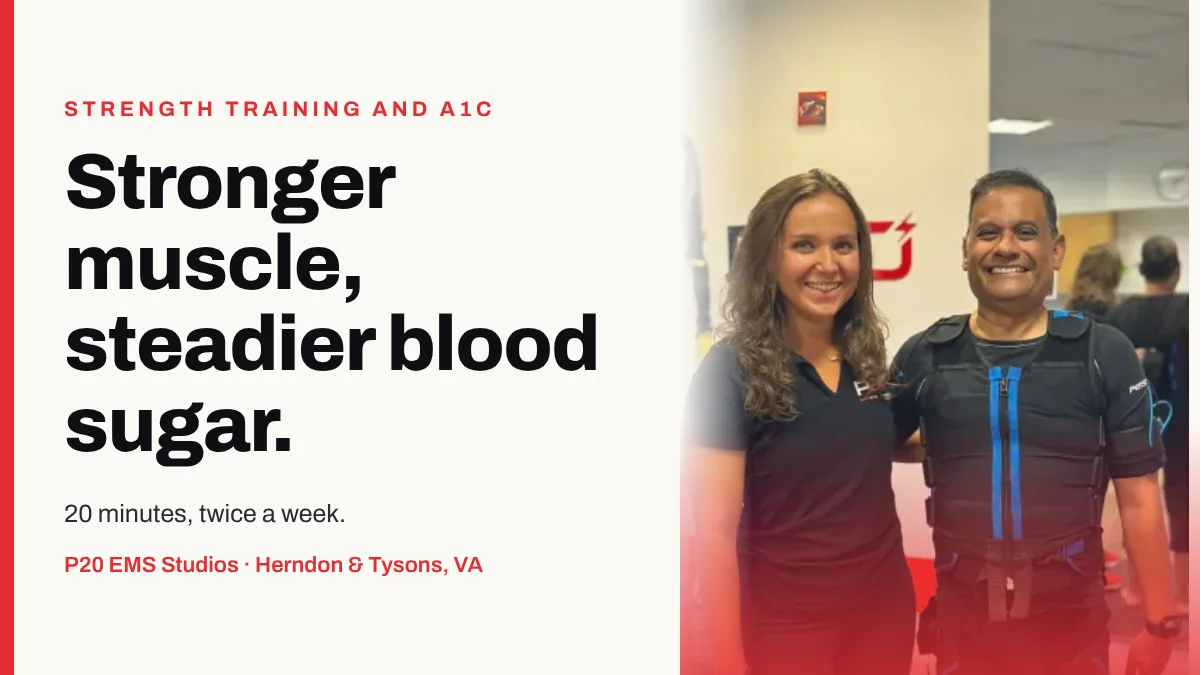
Tomorrow, November 14, is World Diabetes Day, and November is American Diabetes Month. This year’s World Diabetes Day theme, set by the International Diabetes Federation and the World Health Organization, is “Early action on diabetes.”
Early action matters because the numbers are larger than most people realize. According to the CDC’s National Diabetes Statistics Report:
- 115.2 million American adults have prediabetes.
- More than half of adults 65 and older (52.1%) have prediabetes.
- 40.1 million Americans have diabetes, and more than one in four adults who have it (27.6%) have not been diagnosed.
Most advice for blood sugar comes down to “eat better and walk more.” Both help. But there is a third piece that gets far less attention, and it is the one we work on every day in our Herndon and Tysons studios: muscle.
This article explains why muscle matters so much for blood sugar, what the research says about strength training and A1C, where EMS fits (including what is and is not proven), and a simple plan to bring to your doctor.
Know your number first
An A1C test is a simple blood test that reflects your average blood sugar over roughly the past three months. The American Diabetes Association (ADA) uses these ranges:
| A1C result | What it means |
|---|---|
| Below 5.7% | Normal |
| 5.7% to 6.4% | Prediabetes |
| 6.5% or higher | Diabetes |
The ADA’s 2026 Standards of Care recommend that screening start at age 35 for everyone, and earlier for adults who are overweight and have other risk factors such as a family history or physical inactivity.
One detail is especially relevant in Northern Virginia. For people of Asian ancestry, the ADA sets the weight threshold for earlier testing at a BMI of 23 instead of 25, because type 2 diabetes tends to develop at a lower body weight. About one in five Fairfax County residents is of Asian descent, so many of our neighbors in Herndon, Reston, McLean and Tysons should be tested sooner than the standard charts suggest, even if they look and feel lean.
If you do not know your A1C, asking for one at your next physical is the first early action.
Why muscle is your blood sugar’s biggest customer
Muscle is where the sugar goes. After a meal, insulin moves glucose out of your blood and into your tissues. Under insulin’s direction, skeletal muscle takes up roughly 80% of that glucose. When muscle stops responding well to insulin, sugar stays in the blood. Researchers call that muscle insulin resistance, and it is one of the earliest steps on the road to type 2 diabetes.
Working muscle does not need to wait for insulin. When a muscle contracts, it pulls glucose in through a second pathway that works even when insulin is not doing its job well. That is why a single workout can lower blood sugar for hours afterward, and why regular training improves insulin sensitivity over time.
More muscle, better numbers. In a national study of 13,644 U.S. adults, UCLA researchers found that each 10% increase in muscle mass relative to body weight was associated with an 11% reduction in insulin resistance and a 12% lower prevalence of prediabetes or diabetes. That study shows an association, not cause and effect, but it points in the same direction as the training research below.
The catch is age. Adults lose muscle every decade after 40 unless they train to keep it, which is one reason prediabetes becomes so common after 65.
What the research says about strength training and A1C
Strength training lowers A1C. A 2024 meta-analysis pooled 46 randomized controlled trials with 2,130 adults who had type 2 diabetes. Resistance training lowered A1C by an average of 0.50 percentage points compared with no training, and lowered fasting glucose by about 12 mg/dL.
It works about as well as cardio. A 2022 meta-analysis in BMJ Open Diabetes Research & Care found no significant difference in A1C between resistance training and aerobic training. You do not have to choose the treadmill if your knees prefer something else.
Getting stronger is what counts. The same analysis found that programs producing larger strength gains produced larger A1C reductions. Going through the motions is not enough. The muscle has to be challenged.
Two to three sessions a week is the recommendation. The ADA’s 2026 Standards of Care encourage adults with diabetes to do 150 minutes or more of aerobic activity a week, plus 2 to 3 sessions a week of resistance exercise on nonconsecutive days, and to break up sitting at least every 30 minutes.
For prediabetes, lifestyle change is powerful. In the landmark Diabetes Prevention Program, an intensive lifestyle program cut the development of type 2 diabetes by 58% over three years. The ADA notes that a prevention plan can include resistance training alongside aerobic activity.
Where EMS fits, and what is and is not proven
We want to be straightforward about this. The large trials above used conventional resistance training with weights and machines. The research on whole-body EMS and blood sugar is promising but early.
The best-known study is from a German heart and diabetes center, published in Diabetes Technology & Therapeutics in 2015. Fifteen adults with type 2 diabetes, average age about 62, trained in a whole-body EMS suit twice a week for 20 minutes over 10 weeks. Their average A1C fell from 7.7% to 7.2%, and fasting blood glucose fell from 164 to 133 mg/dL. It was a small study with no control group, so it is a starting point, not proof. A randomized trial of whole-body EMS in people with prediabetes is under way.
What we can say with confidence is this: EMS is strength training. The suit makes your muscles contract against resistance while you move, and a 20-minute session works all the major muscle groups at once. For blood sugar, the strength training you actually do twice a week beats the perfect gym program you never start.
EMS is not a treatment for diabetes and does not replace medication, nutrition or your doctor’s advice. It is one practical way to get the resistance exercise the guidelines call for.
New this week: strength training also protects muscle on tirzepatide
Many people managing blood sugar or weight now take a GLP-1 medication. On November 9, Nature Medicine published the T-REx trial from the University of Western Australia: 120 adults aged 50 to 70 took tirzepatide (the medication in Mounjaro and Zepbound) for 40 weeks, and half added resistance training three times a week.
Both groups lost about the same weight, roughly 22 kg (49 lbs). The difference was in what they kept:
- The training group lost about a quarter less lean tissue (3.57 kg versus 4.67 kg).
- Strength went down in the medication-only group and went up in the training group on every test, upper and lower body.
The participants in this trial did not have type 2 diabetes, but the lesson carries over to anyone on these medications: the drug handles the weight, and resistance training protects the muscle. Our GLP-1 guide covers how we adapt sessions for clients on these medications.
Harisha’s numbers
Harisha was diagnosed with diabetes in 2007. He took his medication and worked out for years, in group classes and with personal trainers, without seeing much change. He walked past our studio for two years before co-owner Carmen Ruiz persuaded him to try a session.
Over his first 24 sessions, his squats per minute rose from 40 to 59 and his plank hold went from 1:50 to 4:00. In his words:
“My blood sugar has been lower since starting P20. My A1C is 6.2, which is actually in the prediabetic range.”
Harisha’s results are his own and came alongside his medical care, not instead of it. They are not a promise of what anyone else will see. You can read his full story.
Why a 20-minute session is the strength training people keep
It fits the guideline and the calendar. Two 20-minute sessions a week on nonconsecutive days is the low end of what the ADA recommends for resistance exercise. Door to door you are in and out in about 35 minutes, with training clothes provided.
It is easy on joints. The suit is the resistance, not a barbell. Many people with prediabetes or diabetes also have sore knees, a bad back or extra weight that makes a traditional gym uncomfortable. Our clients with joint and back pain train hard without loading the joint.
It is coached, so the muscle is actually challenged. The research says strength gains drive the A1C benefit. Your trainer sets the intensity muscle group by muscle group and raises it as you get stronger.
It is measured. We track your weight, waist and strength as you go, so you can put your studio numbers next to your lab numbers.
Your early action plan
- Get your A1C. Ask for it at your next physical, especially if you are 35 or older, have a family history, or are of Asian ancestry with a BMI of 23 or more.
- Book two strength sessions a week on nonconsecutive days. Put them in your calendar like any other appointment. One session a week is a start if two is not possible yet.
- Move after meals and break up sitting. A 10 to 15 minute walk after dinner helps your muscles clear glucose. At work, stand up or walk at least every 30 minutes.
- Protein with every meal. Muscle needs protein to grow, and it helps steady the rise in blood sugar after you eat. Ask your doctor or a dietitian what amount is right for you.
- Tell your trainer about your medications. If you take insulin or a sulfonylurea, ask your doctor how to exercise safely, check your blood sugar before and after your first sessions, and bring a fast-acting snack. We will set the intensity around how you feel that day.
- Retest in three months. A1C reflects about three months of blood sugar, which is about 24 sessions at twice a week: the length of our Triple 8 Journey.
Ready to take early action?
A $35 trial session is a 20-minute workout with a coach, the suit and training clothes included. Start this week and your first retest will come after roughly a dozen weeks of consistent strength training.
Book your $35 trial session at P20 Herndon or P20 Tysons, or call or text us and mention this article:
- Herndon: 703-559-4040
- Tysons: 571-407-1199
We will take it from there.
Sources
- Centers for Disease Control and Prevention. National Diabetes Statistics Report (2023 estimates; page reviewed September 2026). cdc.gov/diabetes/php/data-research
- International Diabetes Federation. World Diabetes Day 2026-27: Early action on diabetes. idf.org
- American Diabetes Association Professional Practice Committee. 2. Diagnosis and Classification of Diabetes: Standards of Care in Diabetes 2026, Diabetes Care. doi.org/10.2337/dc26-S002
- American Diabetes Association Professional Practice Committee. 3. Prevention or Delay of Diabetes and Associated Comorbidities: Standards of Care in Diabetes 2026, Diabetes Care. doi.org/10.2337/dc26-S003
- American Diabetes Association Professional Practice Committee. 5. Facilitating Positive Health Behaviors and Well-being to Improve Health Outcomes: Standards of Care in Diabetes 2026, Diabetes Care. doi.org/10.2337/dc26-S005
- DeFronzo RA, Tripathy D. Skeletal muscle insulin resistance is the primary defect in type 2 diabetes, Diabetes Care, 2009. doi.org/10.2337/dc09-S302
- Srikanthan P, Karlamangla AS. Relative muscle mass is inversely associated with insulin resistance and prediabetes, Journal of Clinical Endocrinology & Metabolism, 2011. doi.org/10.1210/jc.2011-0435
- Wan Y, Su Z. The impact of resistance exercise training on glycemic control among adults with type 2 diabetes: a systematic review and meta-analysis of randomized controlled trials, Biological Research for Nursing, 2024. doi.org/10.1177/10998004241246272
- Jansson AK et al. Effect of resistance training on HbA1c in adults with type 2 diabetes mellitus and the moderating effect of changes in muscular strength, BMJ Open Diabetes Research & Care, 2022. doi.org/10.1136/bmjdrc-2021-002595
- van Buuren F et al. Electrical myostimulation (EMS) improves glucose metabolism and oxygen uptake in type 2 diabetes mellitus patients: results from the EMS study, Diabetes Technology & Therapeutics, 2015. doi.org/10.1089/dia.2014.0315
- Green DJ et al. Resistance exercise to attenuate lean mass loss during tirzepatide therapy for obesity: a randomized controlled trial, Nature Medicine, November 2026. doi.org/10.1038/s41591-026-04752-5
- U.S. Census Bureau. QuickFacts: Fairfax County, Virginia. census.gov/quickfacts/fairfaxcountyvirginia
This article is for general information only and is not medical advice. EMS training is not a treatment for diabetes or prediabetes. Talk to your doctor before starting any exercise program, especially if you take insulin or other glucose-lowering medication. EMS is not suitable for people with pacemakers or other implanted electrical devices, heart disease, epilepsy, or who are pregnant.